

Year 11 Revision
Our current year 11 and 13 students have had a tough few years, with Covid impacting their flow of learning. As a result, the government has allowed GCSE students to use an exam formula sheet in the past, and for summer 2026 the Department For Education has decided that students will have access to these formulae again. However, students still need to remember a number of common formulae and methods, so revision is largely unchanged as a result. These sheets will be provided for the upcoming final trial exams.
GCSE Formula sheet - Foundation
GCSE Formula sheet - Higher
Revising for the summer exams in May
Students have now be given a 7-week revision schedule (attached below) which gives them topics to revise each night to ensure that they are ready for the exams. Students now have to spend time every evening, Monday to Friday, revising Maths (along with other subjects), or using weekends as needed to stay on track. It's hard work, but a disciplined routine ahead of the exams (not last minute cramming) is what is needed to get those great results in August.
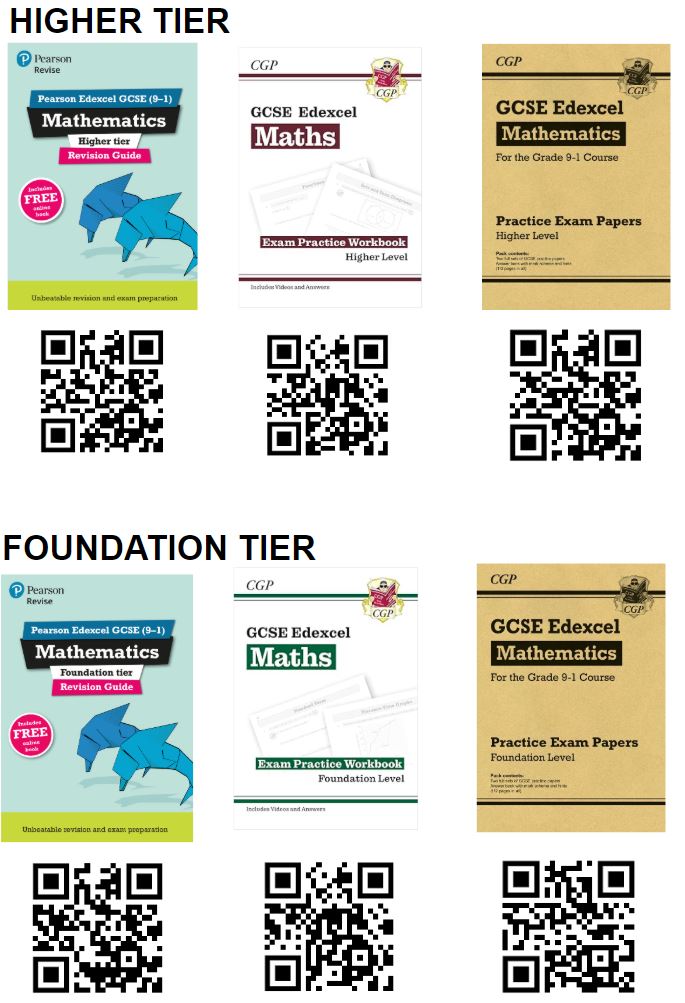
Students will need a large source of practice questions for revision. Students can use MathsWatch (which is free for students) or their Maths folders/books, but there are also preprinted resources that may be useful, containing questions (and answers):
Effective Maths revision is:
- Students using the schedule to select the listed topic on MathsWatch (or in a printed book)
- Fast forward the video to the part where practice questions are shown
- Students pause the video, get a physical pen & paper and attempt the questions (we've provided them a blank revision book to use)
- Unpause the video and check answers. If correct, fast forward again to look for the next set of questions to try, but if incorrect, rewind the video, watch the explanation/method and try the questions again.
- There are more questions by clicking the 'interactive questions' button above the video
- Come and find a teacher when stuck or confused
Students need to be independent and choose how much time they spend on their weak areas. Some topics are easy and only need 5 minutes of revision, but other topics will need half an hour. In general though, it should take up to 45 mins of their evenings between now and the actual exams in May/June.
The GCSE revision schedule has now been given out, but we've also provide links to recordings of GCSE Maths exams being answered, and they can be found HERE.
Please understand that a student's final grade is their responsibility. Our teachers always go above and beyond to support students in a wide variety of ways, but students get the grade they deserve. We expect them to put in significant revision effort as exams approach, seek out teachers for help (during breaks and lunches when we deliberately make ourselves available) and wrestle with challenging content rather than focus on content they already understand. If they do this, they will succeed, but just turning up to class isn't enough around exam time. Students need to put in significant personal revision time in order to achieve those target grades, and no teacher, friend or family member can do revision for them - it has to be them working to fill the gaps that exist in their brain.
If you have any questions about exam support for your son/daughter, please contact Mr Jones (s.jones@dms.fodt.co.uk) or contact your son/daughter's Maths teacher.